In Megan Hunter's article, "Seeing the World Anew: on climate change fiction," Hunter argues that literature on climate change is not only important as cultural artifacts, but that it can quite literally change our perspective and interaction with the physical environment. So if this is true, then what responsibilities do we as writers and advocates for the environment have? For Hunter, it seems that she thinks that cli-fi should move more toward imagining the future of daily life that climate change will have on us; if what people are concerned with is the disconnect the general population feels about the impact of climate change, then our fiction should work toward reconnecting the population through an imagining of the personal within a changed environment.
Through this, we can look at climate change disasters not as fiction, but as a question about how we as a society will function in a future where the affects of climate change will become more and more apparent. Something Hunter wrote that stuck out to me was when she says, "We want to know about how we destroy ourselves." If we cannot save human life as we know it now, what will happen to humanity in the future? How will we go on? Will we go on? How might individuals react and adapt in the future? What I love about this (that we're fascinated with how we're going to destroy society) is that in some ways it's not as bleak and dreary of an idea as it superficially seems. Life as we know it now may end, but it was always going to end. There are some things we can't reverse or save; but even after the most devastating changes, perhaps we also look to cli-fi and dystopians with some hope. That humans still go on, and that perhaps the earth will also move on.
So then, what is our goal as nature writers? What responsibilities do we have in shaping how our society thinks about climate change? Is it to provide solace? Is it to provoke fear? Is it to inspire people to work harder for a better future? Where do we stand in this imagining of the future?
Wednesday, January 31, 2018


Tuesday, January 30, 2018
Meta Post: Human Nature
It is not a new conversation to consider what, firstly, nature is and secondly, what nature happens to mean in communication with humanity. And that was the primary topic for our first week's post over the readings of Mckibben and the TedTalk with Emma Harris. There is was a prominent point in discussion that these two speakers have very different definitions and outlooks of what nature is and how humanity now tends to interact with our next-door neighbor Mother Nature.
Our overall theme for the posts? Nature is beautiful and there is a compelling need to help protect where we are living for now, but a partial inability to do so without better solutions or a hefty amount of time on our sides. There was, however, several small step solutions of at least preservation which usually included reporting about the surroundings and making better Eco habits with the earth in mind like gardening and material clean up.
I leave with this thought: some people consider nature violent. What is the difference between human and nature response? It is not in some ways very similar in reaction? It could be argued as a emotional response. After all, if you were the Earth or the concept of "Mother Nature" would you not react in the same ways? Humanity is hurting and nature is simply responding in kind. Think of our time on this planet as a dialogue. A good dialogue is needed to be able to change anything for the better.
Looking forward to where our next discussion goes!
Our overall theme for the posts? Nature is beautiful and there is a compelling need to help protect where we are living for now, but a partial inability to do so without better solutions or a hefty amount of time on our sides. There was, however, several small step solutions of at least preservation which usually included reporting about the surroundings and making better Eco habits with the earth in mind like gardening and material clean up.
I leave with this thought: some people consider nature violent. What is the difference between human and nature response? It is not in some ways very similar in reaction? It could be argued as a emotional response. After all, if you were the Earth or the concept of "Mother Nature" would you not react in the same ways? Humanity is hurting and nature is simply responding in kind. Think of our time on this planet as a dialogue. A good dialogue is needed to be able to change anything for the better.
Looking forward to where our next discussion goes!
Meta Post: You gotta fight! For your right! To garrrdennn
Inevitably, this week’s blog posts revolved around the
central concept of nature, particularly our relationship with it as humans. Posts
ranged from discussions of what “nature” really is to how we can help preserve
it.
One of the most talked about topics was, as mentioned, our human relationship with nature. There seemed a lot of interest in figuring out what exactly our relationship with Mother Nature is: parasitic? Neutral? Even amicable? Most of our peers seem to think humans are more destructive than nature, and there is no way to fully restore Earth to what it once was. Despite this belief, though, there are still several believers/supporters in doing what we can to try to reverse some of our effects. We sought sources on ways to help restore our planet through trustworthy websites like National Geographic and MIT, and some of us thought locally about ways we can restore some natural beauty through more political acts like guerilla gardening.
So, it seemed that despite our common thinking on the impossibility of completely salvaging Earth and it’s natural beauty, we still feel a compelling desire to do something to help. Whether it’s planting flowers in pot holes or observing and recording nature through journals, something inside each of us respects our natural, wild surroundings. Something inside each of us wants to fight for the beauty of "nature," no matter our definition of it.
One of the most talked about topics was, as mentioned, our human relationship with nature. There seemed a lot of interest in figuring out what exactly our relationship with Mother Nature is: parasitic? Neutral? Even amicable? Most of our peers seem to think humans are more destructive than nature, and there is no way to fully restore Earth to what it once was. Despite this belief, though, there are still several believers/supporters in doing what we can to try to reverse some of our effects. We sought sources on ways to help restore our planet through trustworthy websites like National Geographic and MIT, and some of us thought locally about ways we can restore some natural beauty through more political acts like guerilla gardening.
So, it seemed that despite our common thinking on the impossibility of completely salvaging Earth and it’s natural beauty, we still feel a compelling desire to do something to help. Whether it’s planting flowers in pot holes or observing and recording nature through journals, something inside each of us respects our natural, wild surroundings. Something inside each of us wants to fight for the beauty of "nature," no matter our definition of it.
As we move forward with these ideas and think about how this affects creative writing and the environment, consider why we care so much. What, in humans, has changed from the era of industrialization to the era of environmental protests?
(Let's take the Beastie Boys for it and keep fighting, shall we?)
Meta Post: Violent Natures
One topic that generated multiple responses involved the violence of Mother Nature vs. Human Nature. Most people agree that Human Nature is more violent than Mother Nature. Where most species are violent purely for survival purposes, humans are violent for leisurely comforts. We are responsible for the destruction of the Earth and the eradication of many species. The damage we have caused far out weighs the violence of Mother Nature.
This discussion also brought up some interesting ideas on reversing the damage we caused to the Earth. There is disagreement over whether or not we can completely reverse it. However, everyone agrees that to create any significant, positive change, it would take years of hard work. I personally believe that full recovery is impossible, but I hope that we can work towards a drastically less harmful way of living.
This discussion also brought up some interesting ideas on reversing the damage we caused to the Earth. There is disagreement over whether or not we can completely reverse it. However, everyone agrees that to create any significant, positive change, it would take years of hard work. I personally believe that full recovery is impossible, but I hope that we can work towards a drastically less harmful way of living.
Meta Post: The Definition of Nature
Since the two texts we read and watched for these blog posts were about the definition of nature, the first obvious trend seen through this thread is a continuation of what that definition is. McKibben and Marris have pretty different ideas of what nature means to them, but people also seem to be concerned not only with defining nature, but how that definition changes the way we interact with it. What do we do when humans take scenes of nature and then politicize it? Is this right? Is it even possible to portray nature without politicizing it? What do we do when nature is destructive? Through our definitions of nature, is it nature that's doing the destroying, or is it humans?
How we chose to see and define nature changes the way we see ourselves and our understanding of humans' roles on earth. It seems that most people align themselves with Marris' perspective on nature; that since we are also animals, we are always going to be a part of nature, and that it is impossible to completely separate the human from the nonhuman environment around us. Defining nature, then, seems to also be a question of defining humanity. What is our purpose in nature? What is our purpose (in general)? What doe sit mean to be in nature; and by default, what does it mean to be human?
How we chose to see and define nature changes the way we see ourselves and our understanding of humans' roles on earth. It seems that most people align themselves with Marris' perspective on nature; that since we are also animals, we are always going to be a part of nature, and that it is impossible to completely separate the human from the nonhuman environment around us. Defining nature, then, seems to also be a question of defining humanity. What is our purpose in nature? What is our purpose (in general)? What doe sit mean to be in nature; and by default, what does it mean to be human?
Friday, January 26, 2018
A Nature of Imagination
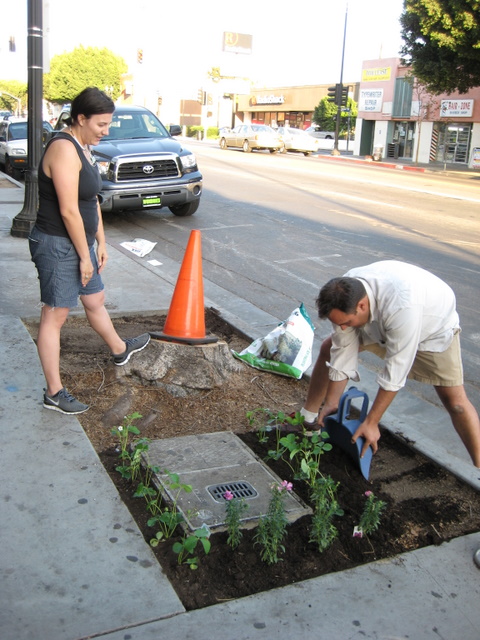 |
| Guerrilla Gardeners plant flowers on a Los Angeles Street |
The two texts assigned
for this blog created a clash of terminology about a conflicted relationship. For
McKibben, “nature” is a depressing word, as he believes none remains. For
Marris, though, “nature” instigates curiosity. Both definitions change the relationship
between humans and nature, and they create two paths: despair over the past or
hope for the future.
For McKibben, the
relationship between humans and nature is a battle. Nature is at war with humans.
Even after “Nature has endured and outlived and with dignity reclaimed so many
schemes and disruptions of man,” McKibben argues that climate change has ended
nature. If nature must “endure” and “outlive,” this assumes that nature is engaged
in a fight. Nature is fighting humans for the same resource—the world—and by
the competitive exclusion principle, nature is losing. McKibben misses the
hubris in his argument that assumes humans have enough power to recreate the
entire world, or that human society is impenetrable and permanent. We are no
more permanent than nature, perhaps even less so, as nature continues to
reclaim our own cultivated spaces.
Even
as nature reclaims our cultivated spaces, humans aren’t quick to claim nature
as their neighbor. Emma Marris argues that although most Americans live near
natural subjects or urban parks, they cannot recognize it because the
definition of nature is limited to “wild,” curated, landscapes—National Parks. She
argues for a new understanding that brings human society and nature together
with nature as “anywhere where life thrives, where multiple species live
together...where things are growing.” This definition acknowledges nature’s “self-willed”
transplantation into urban areas. Instead of drawing a line between “nature”
and “human,” Marris acknowledges that humans are natural. Life indicates
natural forces. Natural forces imply relationship. Seeds evolve. Children touch
nature. Grad students explore backyards. The new term allows us to embrace
curiosity instead of fear.
 |
| A Guerrilla Garden in Perth, Australia |
McKibben is afraid, and
perhaps rightfully so. Chemicals and plastics poison our water. Deforesters and
developers annihilate diverse habitats. Such actions inhibit and destroy life. Yet
nature lives on.
Limiting our definition
of “nature” to untouched “wilderness” not only limits our curiosity for the
natural world but it limits ourselves and our own growth as humans. McKibben
writes that he escapes to the outdoors because in the “outdoors we venture into
a sphere larger than ourselves.” The outdoors is a space of imagination. It is
a space where wild things, and wild ideas, can grow.
If we allow ourselves a
wider definition of nature, then we expand our sense of who we are in the world
instead of relying on exclusion and fundamental lines. We meet the sphere
larger than ourselves—nature—and expand our imaginations wherever we find it. When
we expand our imagination, we find endangered species in our overgrown yard and
prairie hideaways over old train tracks. We find new understandings of ourselves
and our world.
What if we encountered
the world in this way? Children, who ordinarily might have stayed indoors at
their computers, might instead run through, touch, and play with nature. Cities
might integrate natural subjects into urban planning blueprints. Natural public
spaces, more inviting than concrete, might bring neighborhoods together. Perhaps,
we might find a way to love nature, wherever, and whoever, we are.
Questions to consider:
Where in Muncie, could you find an untraditional plot
of “nature”? (Perhaps one that fits more with Emma Marris’ guidelines?)
OR
Imagine that the ideas “Nature” and “Humankind” are embodied
by two people. What kind of a conversation would they have? What would their
relationship be like? What would an ideal relationship look like between Nature
and Human?
P.S.
I included photos of some
early efforts to redefining nature in urban spaces. Guerrilla Gardeners hunt for
unclaimed patches of soil and repurpose them into miniature parks and gardens
for the public. Imagine them like St. Francis Robin Hood Gardener Vigilantes.
P.P.S.
Does anyone want to start
a Guerrilla Gardening club?
Launch Post: Human Nature vs. Mother Nature
In Lucille Clifton's poem "the earth is a living thing," she beautifully explains the violence of Mother Nature by personifying the earth as an actual living thing. Each stanza describes different characteristics of Earth, portraying Earth's strength, carnivorous nature, mystery, and beauty. Lines like, "black shambling bear" "tossing mountains into the sea" or "black hawk circling the
burying ground," emphasize the destructive power of Mother Nature. While lines like "diamond blind in the black belly of coal" emphasize the integral goodness of Earth.
In a similar setting, human nature can be seen as just as violent. Therefore, if the earth is a living thing, which this poem is arguing, why are humans destroying it? We pollute, pillage, and consume Earth's resources to an unhealthy level. We are increasingly taking advantage of our planet as a parasite does to its host. Humans tend to look at what Earth can do for them rather than what they can do for it. There are actions in place to alleviate climate change, like the Paris Convention and finding renewable sources of energy, but efforts can only go so far if mankind cannot overcome human nature by avoiding abandoning these movements and making conscious choices that are beneficial to taking care of the Earth.
After considering this poem and its message, I ask, is Human Nature or Mother Nature more violent? If humans begin to think of Earth as a living thing as Lucille Clifton suggests rather than just an entity to benefit from, can we reverse the damage that we have already caused? How?
Launch Post - Should Birds Just be Birds?
I was reading "There Are Birds Here" by Jamaal May and I got to thinking about what the poem seems to be saying-- specifically, what it's suggesting about poetry. To me, it seems like the speaker is correcting certain interpretations others may have about poems (likely poems about Detroit).
More than once the speaker says "no" before explaining what an image actually is as opposed to a different metaphor. For example, "No, / I don't mean the bread is torn like cotton, I said confetti, and no / not the confetti / a tank can make of a building." The speaker is insisting on their own images, notably ones that are not necessarily connected to calamity, as with a tank leveling a building, or slavery, as with the cotton. When the speaker describes the neighborhood as "tattered and feathered / as anything else," it seems to me like they are choosing not to romanticize or overstate the images in the poem, keeping them more direct and concrete instead.
This all leads to my question: Would you agree with this idea that we should romanticize or even politicize images less in poetry? When is it okay to expand into metaphors and when should we keep things more down to earth?
More than once the speaker says "no" before explaining what an image actually is as opposed to a different metaphor. For example, "No, / I don't mean the bread is torn like cotton, I said confetti, and no / not the confetti / a tank can make of a building." The speaker is insisting on their own images, notably ones that are not necessarily connected to calamity, as with a tank leveling a building, or slavery, as with the cotton. When the speaker describes the neighborhood as "tattered and feathered / as anything else," it seems to me like they are choosing not to romanticize or overstate the images in the poem, keeping them more direct and concrete instead.
This all leads to my question: Would you agree with this idea that we should romanticize or even politicize images less in poetry? When is it okay to expand into metaphors and when should we keep things more down to earth?
Launch Post One: What is nature?
In her TedTalk Emma Marris
debates the definition of nature and what qualifies as nature. In the beginning
she mentions how our future children will essentially have no nature when they
are adults. To find the solution to this she poses the question, what counts as
nature? Bill Mckibben has said, "Because nature was a thing apart from man
and because climate change meant that the Earth was altered by man and nature
is over." Marris does agree that man has altered the world by recognizing
that man has changed the chemistry of the air to obtain 42% more carbon dioxide
than if you lived in 1750. However, she disagrees with his definition of nature.
"I disagree with his definition of nature because fundamentally we are all
animals. We evolved on this planet with all of the other plants and living
organisms. So, I think that nature does not have to be untouched by man or
woman. I believe nature is anywhere where life thrives, anywhere with multiple
species living together, anywhere where it's green/blue filled with life and
growing." She does make sure to acknowledge that certain parts of nature
speak louder than others. She uses examples such as The Great Barrier Reef,
National Parks, and other nature preserved places. Marris then digs deeper and
explains how even those places have been impacted by humans. Marris references
the example of extinction of ice age mammals because of human interaction. This
interaction did not only extinct those animals, but it created a ripple effect
that changed the composition of the land. "So, essentially in these Edens’
we are looking at a humanized landscape."
The idea of nature looks
very different with Marris's definition versus Mckibben's definition. This made
me begin to question what nature truly is, or if it's completely gone and we've
just been tricking ourselves into thinking parts of our world are nature to
feed our own satisfaction. It also made me question what could be observed in a
nature journal, according to Marris's definition of nature. After thinking
about these contradicting ideas for a couple hours, I came to the conclusion
that I personally agree with Marris's definition of nature. I agree with her
because I feel that Bill Mckibben's definition of nature is outdated in our ever-changing
natural world. Maybe it's just the part of me that doesn't want to believe that
all nature is actually dead, but I do think that nature include humanity. This
led me to wonder what it would be like to write a nature journal on observing
humans interactions in the natural world. Sitting in the same place everyday at
the same time and just silently observing all of the interactions you see. I am
curious what all of you think about these contradicting definitions. So, the
questions I pose to you are:
1. Do you agree with Marris or
Mckibben on the definition of nature? Why?
2. Based on which definition
of nature you agree with, how does that influence the naturalist idea of keeping a nature
journal?
Wednesday, January 24, 2018
Funeral: For Us His Gold
after Gerald Stern
The insect was yellow with crumpled-black banded legs
and shellacked back that would outlast us
and wistful eyes from what I could discern on that trail
between fields,
and we laid him out in the open air under a sky fast-blue with
change, wedging
a leaf beneath his triple-belted belly so he didn’t rest on
plain dirt,
and we placed two cloverblooms by his head and he was old
you said, could tell by how definite the stripes were, how
complete
the patterns bold and dark, almost engraved,
and he was beautiful in that pasture of thirty-three cows and we
drank
milk in the blaring heat and ate the cake you’d made. We
were
the only humans there—unholy-seeming things with two
legs, dismal histories—
drinking and eating around his elegant husk,
and from the furze, fellow insects rose, a frenzied static
around our bodies,
while he remained in situ an unremitting yellow, the color more
vivid, louder now that he was a remnant. Was color the
purpose here?
Yellow had alerted us to him, and we took care
with leaf and clover to make his bed.
The insect’s gold our togetherness, its death from which we fed.
and shellacked back that would outlast us
and wistful eyes from what I could discern on that trail
between fields,
and we laid him out in the open air under a sky fast-blue with
change, wedging
a leaf beneath his triple-belted belly so he didn’t rest on
plain dirt,
and we placed two cloverblooms by his head and he was old
you said, could tell by how definite the stripes were, how
complete
the patterns bold and dark, almost engraved,
and he was beautiful in that pasture of thirty-three cows and we
drank
milk in the blaring heat and ate the cake you’d made. We
were
the only humans there—unholy-seeming things with two
legs, dismal histories—
drinking and eating around his elegant husk,
and from the furze, fellow insects rose, a frenzied static
around our bodies,
while he remained in situ an unremitting yellow, the color more
vivid, louder now that he was a remnant. Was color the
purpose here?
Yellow had alerted us to him, and we took care
with leaf and clover to make his bed.
The insect’s gold our togetherness, its death from which we fed.
Tuesday, January 23, 2018
Monday, January 22, 2018
Friday, January 19, 2018
Did you know...a baby puffin is called a puffling? How cute!A baby puffin is called a puffling pic.twitter.com/JRfZtJJpIS
— Nature Photography (@NaturePH0T0S) September 19, 2017
Sunday, January 14, 2018
Saturday, January 13, 2018
Snow Feathers
Hope you all are staying warm on this cold, long weekend. In the meantime, take a look at what I found on Twitter yesterday. I thought it was too beautiful not to share. Maybe we could use these ice shapes to find a way to add some good rimes to our poetry.


Word of the day: "rime" - ice that grows, counter-intuitively, out into the direction of the wind, as wind-borne water droplets freeze on contact with existing rime. Rime often forms as elaborate feathers, lending plumage to stone & boulder.— Robert Macfarlane (@RobGMacfarlane) January 13, 2018
Poets' ice. pic.twitter.com/L9GmDZFmjT

Coincidently the Welsh for snowflakes is 'plu eira' which literally translates as snow feathers. This photo taken last sunday on Foel Grach, Carneddau fabulously shows the featherlike structure of rime. pic.twitter.com/9IoS4FBHp4— Sian Shakespear (@SianShakespear) January 13, 2018
Friday, January 12, 2018
Thursday, January 11, 2018
Wednesday, January 10, 2018
Tuesday, January 9, 2018
Welcome!!
Welcome to our class blog. We will use this space to document and expand our conversation about Creative Writing and the Environment. If you come across any articles or artworks you think will add to our conversation, add them here! This is also where you will publish your launch posts, queries, and meta posts. Enjoy!!
Subscribe to:
Posts (Atom)