 |
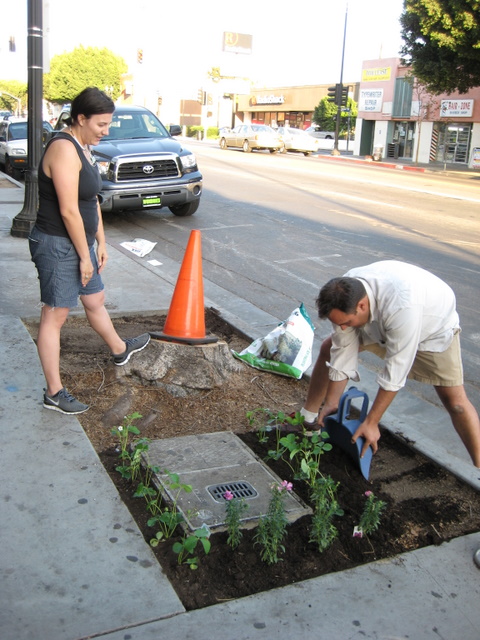
| Guerrilla Gardeners plant flowers on a Los Angeles Street |
The two texts assigned
for this blog created a clash of terminology about a conflicted relationship. For
McKibben, “nature” is a depressing word, as he believes none remains. For
Marris, though, “nature” instigates curiosity. Both definitions change the relationship
between humans and nature, and they create two paths: despair over the past or
hope for the future.
For McKibben, the
relationship between humans and nature is a battle. Nature is at war with humans.
Even after “Nature has endured and outlived and with dignity reclaimed so many
schemes and disruptions of man,” McKibben argues that climate change has ended
nature. If nature must “endure” and “outlive,” this assumes that nature is engaged
in a fight. Nature is fighting humans for the same resource—the world—and by
the competitive exclusion principle, nature is losing. McKibben misses the
hubris in his argument that assumes humans have enough power to recreate the
entire world, or that human society is impenetrable and permanent. We are no
more permanent than nature, perhaps even less so, as nature continues to
reclaim our own cultivated spaces.
Even
as nature reclaims our cultivated spaces, humans aren’t quick to claim nature
as their neighbor. Emma Marris argues that although most Americans live near
natural subjects or urban parks, they cannot recognize it because the
definition of nature is limited to “wild,” curated, landscapes—National Parks. She
argues for a new understanding that brings human society and nature together
with nature as “anywhere where life thrives, where multiple species live
together...where things are growing.” This definition acknowledges nature’s “self-willed”
transplantation into urban areas. Instead of drawing a line between “nature”
and “human,” Marris acknowledges that humans are natural. Life indicates
natural forces. Natural forces imply relationship. Seeds evolve. Children touch
nature. Grad students explore backyards. The new term allows us to embrace
curiosity instead of fear.
 |
| A Guerrilla Garden in Perth, Australia |
McKibben is afraid, and
perhaps rightfully so. Chemicals and plastics poison our water. Deforesters and
developers annihilate diverse habitats. Such actions inhibit and destroy life. Yet
nature lives on.
Limiting our definition
of “nature” to untouched “wilderness” not only limits our curiosity for the
natural world but it limits ourselves and our own growth as humans. McKibben
writes that he escapes to the outdoors because in the “outdoors we venture into
a sphere larger than ourselves.” The outdoors is a space of imagination. It is
a space where wild things, and wild ideas, can grow.
If we allow ourselves a
wider definition of nature, then we expand our sense of who we are in the world
instead of relying on exclusion and fundamental lines. We meet the sphere
larger than ourselves—nature—and expand our imaginations wherever we find it. When
we expand our imagination, we find endangered species in our overgrown yard and
prairie hideaways over old train tracks. We find new understandings of ourselves
and our world.
What if we encountered
the world in this way? Children, who ordinarily might have stayed indoors at
their computers, might instead run through, touch, and play with nature. Cities
might integrate natural subjects into urban planning blueprints. Natural public
spaces, more inviting than concrete, might bring neighborhoods together. Perhaps,
we might find a way to love nature, wherever, and whoever, we are.
Questions to consider:
Where in Muncie, could you find an untraditional plot
of “nature”? (Perhaps one that fits more with Emma Marris’ guidelines?)
OR
Imagine that the ideas “Nature” and “Humankind” are embodied
by two people. What kind of a conversation would they have? What would their
relationship be like? What would an ideal relationship look like between Nature
and Human?
P.S.
I included photos of some
early efforts to redefining nature in urban spaces. Guerrilla Gardeners hunt for
unclaimed patches of soil and repurpose them into miniature parks and gardens
for the public. Imagine them like St. Francis Robin Hood Gardener Vigilantes.
P.P.S.
Does anyone want to start
a Guerrilla Gardening club?


I would love to be in a garden club!
ReplyDelete